From Explore & Exploit to Explore TO Exploit #1
Part #1: Re-Thinking a great idea

We want players to be creative. We want them to be brave. And we want them to win.
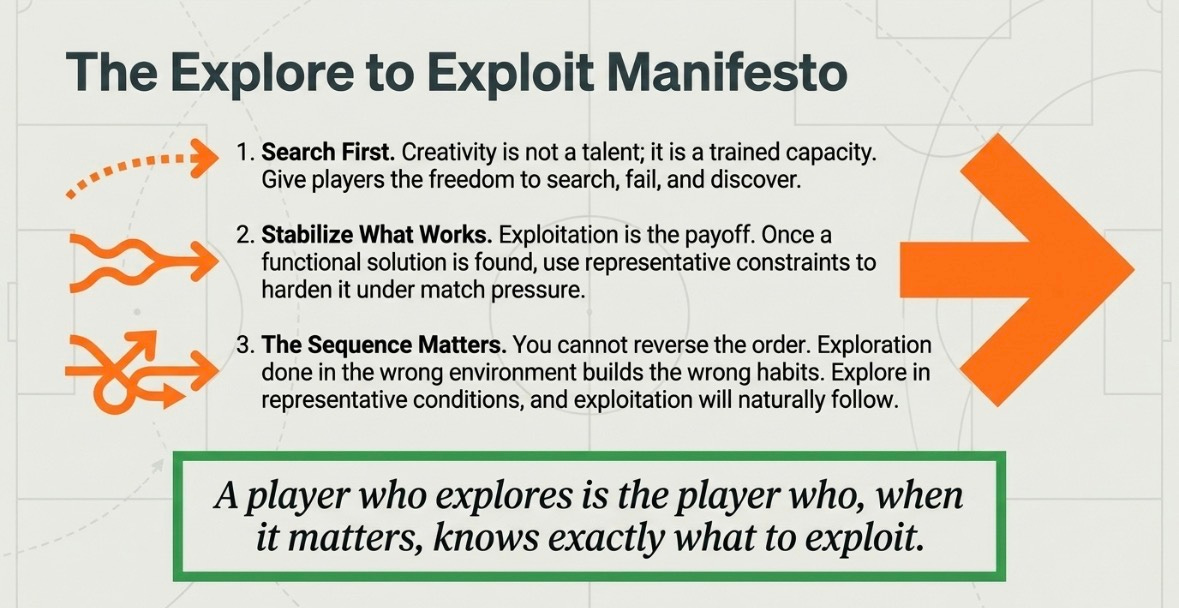
Not as separate ambitions — as the same thing. A player who explores, who reads the game and tries things and searches for the best team option, is the player who, when it matters, knows exactly what to exploit. That is the argument of this series.
Let the game be the first teacher
Over five articles, we build from the theory to the training pitch. We cover how learning actually works, how to design sessions around it, and how to plan across a season — or a childhood — so that exploration is protected, not squeezed out. At the end, you will find full session templates and planning frameworks you can use straight away.
But first: why does any of this matter?
We want players to be creative, brave, and successful. Not as separate ambitions, but as the same thing. A player who explores - who tries things, reads the game, searches for the right option - is the player who, when it matters, knows exactly what to exploit. Explore to exploit is not a coaching slogan. It is how learning actually works.
Too much of coaching still treats these as a trade-off. Spend time exploring, or spend time refining. Be expressive, or be reliable. This series argues that framing is wrong - and costly. The players and teams who are most effective under pressure are the ones who were given the freedom to search, fail, and discover first. Exploitation - the reliable, high-quality execution that wins games - is only possible if exploration has already done its work.
In coaching and practice design, explore and exploit is often framed as a planning problem: how much time should athletes spend trying new solutions versus refining what already works? From an ecological dynamics lens, that framing is too narrow. Exploring is not something we schedule(although we can design to explore); it is something players do continuously as they self-organise in response to the information and constraints around them. The coach’s job is to design environments that make that exploration purposeful - so that what players discover, they can then use.
Ecological dynamics starts with the idea that human movement systems are complex, self-organising organisms with many degrees of freedom. Rather than being programmed from the top down, order in behaviour emerges from the interaction of constraints acting on the performer. The role of a coach, then, is not to specify movement solutions, but to design environments in which useful solutions become more likely to emerge.
IN this series not only will we delve into the why, when where and how? I will build out frameworks for coaches to implement “Explore to exploit” methods into your traingin sessions and build micro and meso cycles to track it in the short and medium term.